11.09.2026
Nauled for Sports: The Circuit Through the Eyes of Ale Moto Corse Riders



If you work with LED strips and aluminum profiles, you know exactly what I’m talking about.
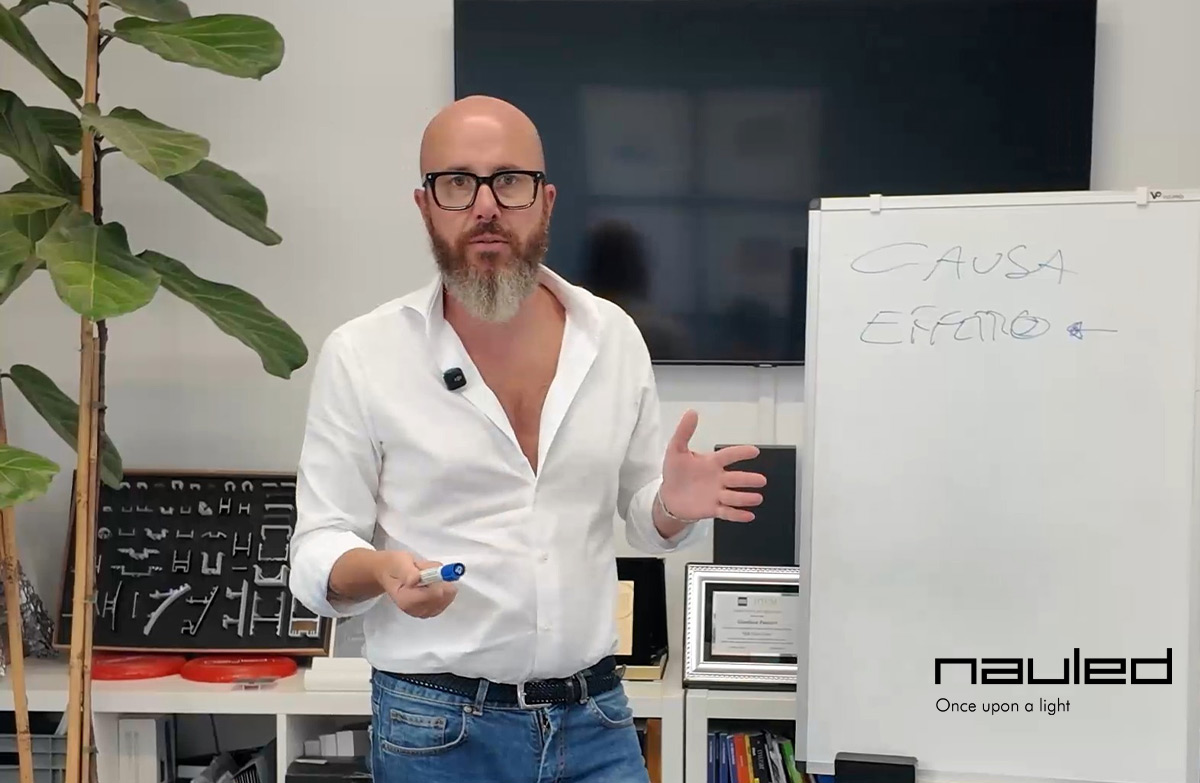
The request comes in, almost always the same: “I need a 45° profile to install in plasterboard, in a cove, to create grazing light.”
It sounds like a precise request. In reality, it’s incomplete.
Because it already starts from the wrong point. It doesn’t start from the light. It starts from the container.
And that’s where the problems begin.
Saying “I need a 45° profile” means you’ve made a decision before even asking the right questions.
Because a profile does not define the final effect. It does not define the quality of light. It does not define the lifespan of the system.
It only defines a direction. It’s like choosing a lens before deciding what scene you want to shoot.
The result? You’re designing backwards.
Before talking about profiles, you should at least be clear on this:
- what you need to light
- how you want to light it
- what kind of effect you want to achieve
Only then do you get to the LED strip. And only after that to the profile.
Because the profile is not an aesthetic detail, it’s a technical component that must support the choice you made before.
If you reverse the order, you lose control over the result.
This is where everything falls apart.
Because even when the choice seems correct — “ok, 45°, perfect” — you actually haven’t decided anything yet.
Two profiles with the same angle may look identical.
Same shape, same design intent, same result “on paper”.
But in practice, they perform in completely different ways.
And you won’t see that difference until it’s too late.
The real issue is not the angle, but the material.
It’s the structure. It’s the amount of aluminum. It’s the ability to dissipate heat.
Because an LED strip is not just light. It’s also temperature.
And if that temperature is not managed, it shortens the product’s lifespan and compromises performance.
What happens is very simple: the lighter the profile, the less material it has, the less it can dissipate. And the less it dissipates, the more the strip suffers.
There is an immediate indicator that helps you understand the difference without diving into complex technical sheets: weight.
Two profiles with the same dimensions can have a huge difference.
One might weigh 30–40 grams, the other more than double.
This is not a detail. This is exactly where you measure the ability to perform correctly over time.
More material means better thermal management. Better thermal management means more stability. And more stability means fewer problems.
And that’s why many keep underestimating it.
Because at the beginning, everything works.
You turn the strip on, the light is there, the effect looks right. The job is done.
But lighting is not measured on day one. It’s measured over time.
And when issues start to show up:
- drop in intensity
- irregularities
- premature aging
it’s no longer a product issue.
It has become your problem.
There are profiles designed to compete on price.
Lighter materials, less structure, lower heat dissipation capacity.
They are not useless. They are simply designed for different applications.
The problem arises when you use them where they don’t belong.
The point is not choosing the “best” profile.
It’s choosing the one that is coherent.
But to do that, you must start from the light, not the support.
First define what you want to achieve.
Then choose the strip.
And only at the end choose the profile that can support that choice.
Not the other way around.
This content is not for everyone.
If your goal is to close a job quickly and stay competitive on price, this reasoning may not matter to you.
But if you want to work with a professional approach, avoid long-term issues and deliver results that truly last, then yes.
This is a distinction you cannot ignore.
▼ Watch the video
If you want to understand how to truly choose the right profile, without relying only on the declared angle -> book a call with us