Video
8.09.2026
Cause and Effect in LED Lighting: Why the Problem Isn't Always What You See



In the world of technical lighting, we are often inclined to judge what we see. A light does not turn on? The spotlight is faulty. A lighting system shuts down? The product does not work.
But is that really the case?
Very often, what we observe is simply the effect of a cause located elsewhere. Understanding this difference is essential for quickly identifying the real problem and avoiding incorrect diagnoses.
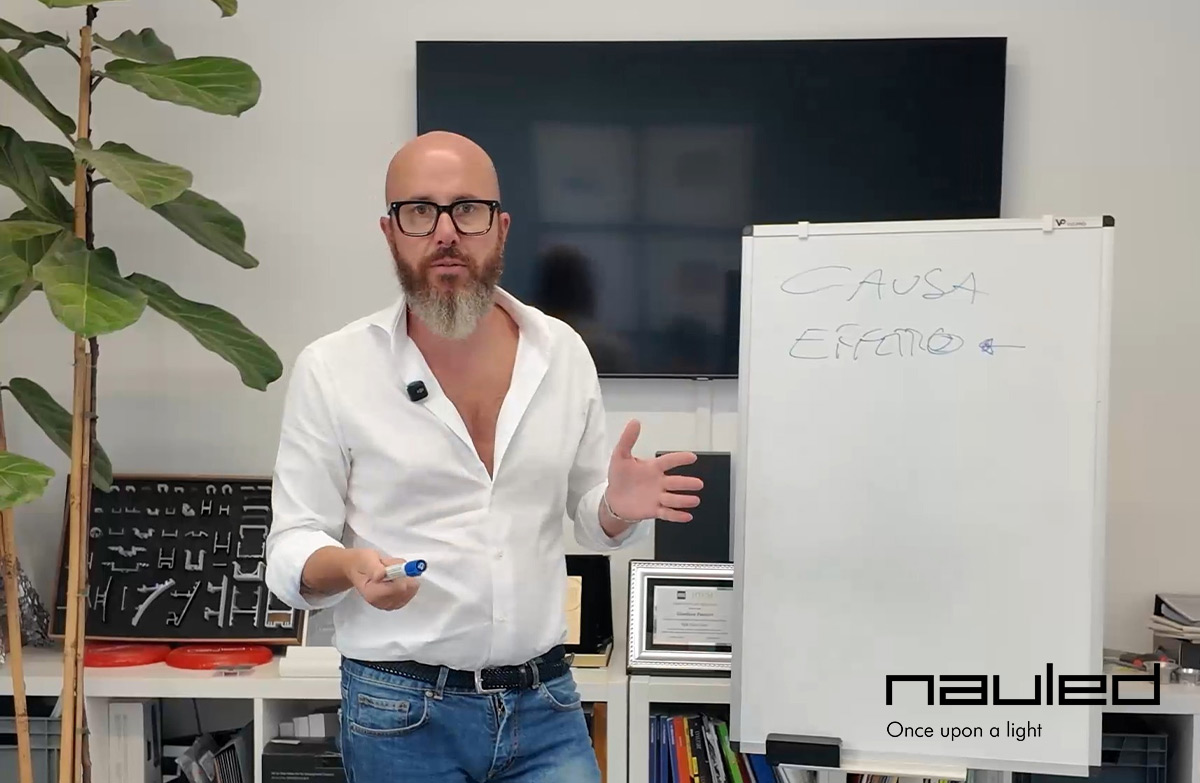
In this video, we explore the concept of cause and effect in LED lighting, examining a real-world case and explaining why the problem is often not where we think it is.
Most lighting problems
"The spotlights do not work in emergency mode."
What the customer saw was the effect: the lights did not turn on. But did the effect really coincide with the cause?
Upon analyzing the situation, it emerged that the spotlights had been replaced only three months earlier during a relamping project and were functioning perfectly under normal conditions.
The problem appeared exclusively during emergency operation.
A deeper analysis revealed that the existing emergency system had not been replaced together with the new spotlights.
More specifically, no one had checked the installation date of the battery inside the emergency kit.
And that was exactly where the problem was.
Emergency kit batteries are subjected to continuous charge and discharge cycles and, over time, gradually lose their ability to store energy.
For this reason, Nauled emergency kit instructions specify that the battery should be replaced every four years.
When the battery can no longer supply sufficient energy, the LED cannot switch on when it is truly needed.
The spotlight was not the problem.
The real cause was a battery that had reached the end of its service life.
Emergency lighting is called into operation precisely when failure is not an option.
For this reason, regular inspections are essential.
A simple periodic inspection can prevent far more serious problems when they matter most.
One of the most widespread beliefs is that an LED lasts forever.
In reality, that is not exactly true.
When we talk about 50,000 hours, it does not mean that the LED will stop working after that period. Rather, it means that its luminous flux may decrease by up to 30%.
Let's look at a simple example.
If a spotlight initially produces 100 lumens, after 50,000 hours it may emit approximately 70 lumens.
The LED continues to operate, but the amount of available light gradually decreases.
100 initial lumens → 70 lumens after 50,000 hours of operation.
Contrary to what many people believe, the LED is one of the most reliable components in the entire system.
Actual failures are generally linked to three factors:
A short circuit can immediately damage the component.
Improper heat dissipation increases the internal temperature of the LED and can significantly reduce its lifespan.
Every light source is designed to operate with specific current values.
An incorrect power supply can cause reduced performance and premature failure.
When a light source stops working permanently, in most cases the problem is not the LED.
Field experience shows that the component most prone to failure is often the driver.
For this reason, troubleshooting should always start upstream:
Only after all these elements have been checked does it make sense to focus on the light source itself.
In 90% of cases, the LED is not the culprit.
Everything upstream of the system should be checked first.
When something does not work, stopping at the visible effect can lead us in the wrong direction.
A light that does not turn on does not necessarily mean that the product is defective.
Very often, the real solution lies in analyzing the power supply, maintenance, batteries, and all the components working behind the scenes.
Understanding the difference between cause and effect makes it possible to identify the root problem, reduce intervention times, and ensure more reliable lighting systems over time.
Don't stop at what you see.
The solution is almost always found in the cause, not in the effect.